
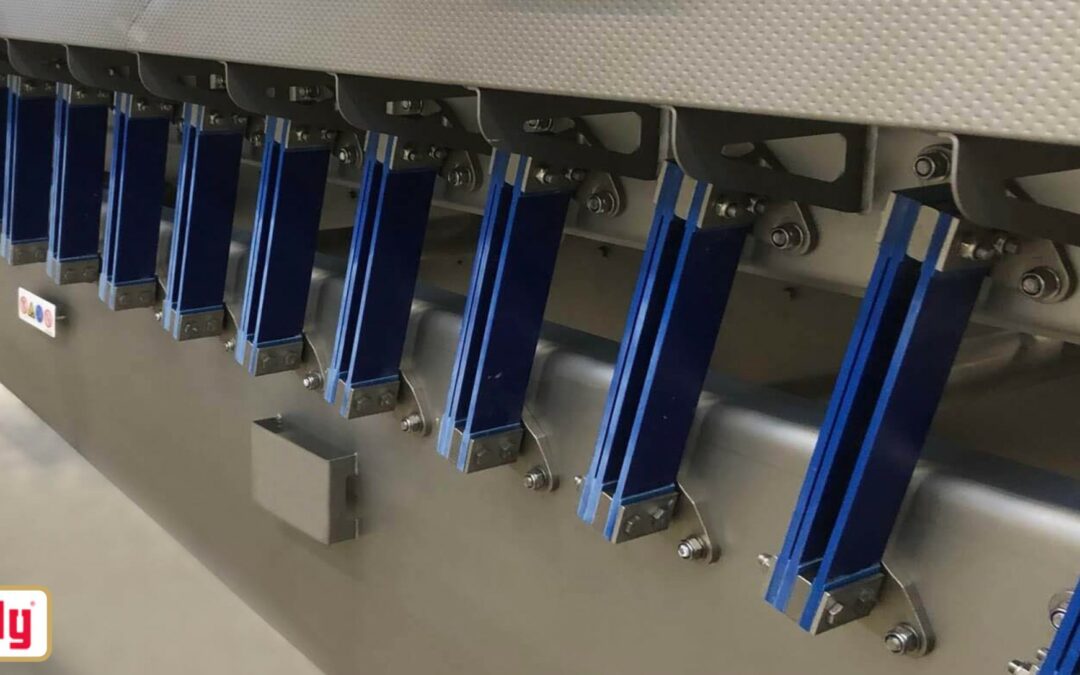
Tynic Automation’s ScotchPLY™ composite springs are an advanced alternative to traditional steel springs. Designed to deliver high strength, flexibility, and longevity across a range of demanding applications, particularly in food production and industrial environments.

What Is ScotchPLY™?
ScotchPLY™ is a high-performance glass-fiber reinforced epoxy composite renowned for its exceptional strength, stability, and durability. What distinguishes this material from the usual G-10 / G-11 composites is its unique fabric layup which entails aligning all material strands in a single direction. The stacking of these unidirectional layers results in a product with remarkable flexural strength when compared to natural G10. Such impressive performance, along with outstanding electrical insulation and fatigue resistance, makes ScotchPLY™ a top choice for industries ranging from manufacturing to aerospace.
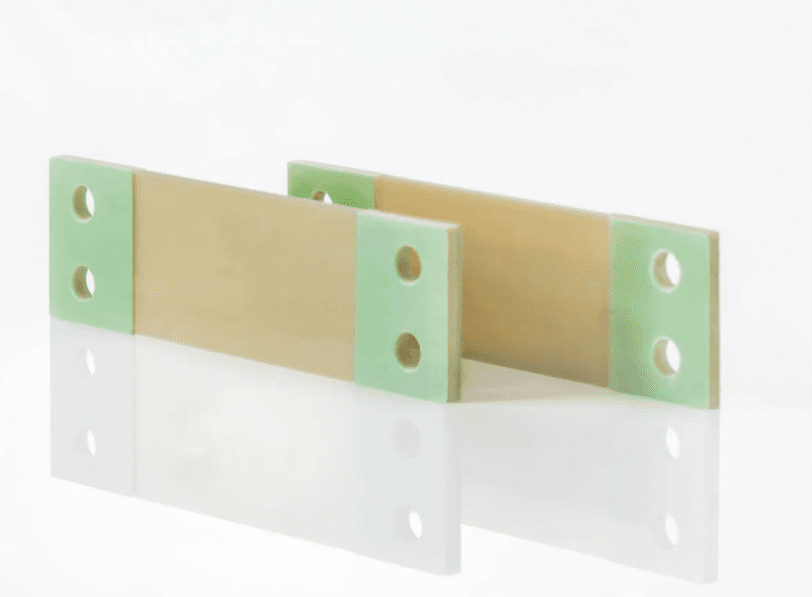
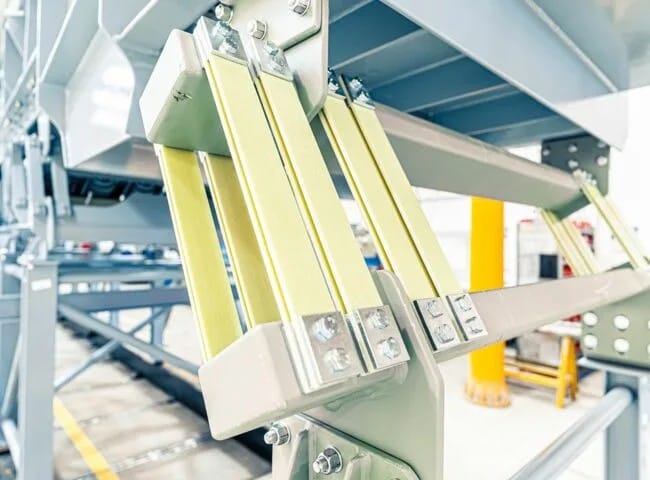
ScotchPLY™ Leafsprings
ScotchPLY™ leaf springs for vibratory conveyors consist of layered and compressed unidirectional prepreg plies. The mechanical properties of a ScotchPLY™ leaf spring may be
adapted to customer requirements and applications during production by orienting individual layers.
Mechanical Strength / Fatigue Life
ScotchPLY™ is renowned for its exceptional strength-to-weight ratio, with a tensile strength of 960 MPa, flexural strength of 1150 MPa, and an elastic modulus of approximately 38 GPa. Despite being significantly lighter than steel (density ~1.8 g/cc), it offers high stiffness and outstanding load performance.
Dimensional Stability
Beyond strength, ScotchPLY™ offers excellent dimensional stability and thermal resistance. Its unidirectional fiberglass and epoxy matrix yield a low thermal expansion (~8.6×10⁻⁶°C). Standard grades operate from -60°C to +120°C, while high-temperature variants endure up to 180°C.
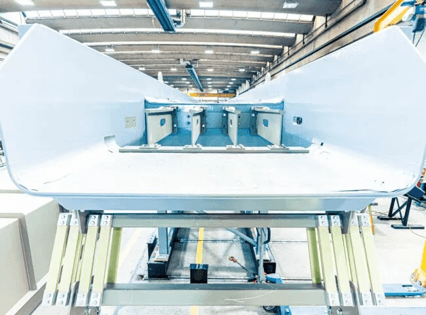
Why use ScotchPLY™ Leaf Springs Instead of Steel?
ScotchPLY™ excels over steel for vibratory conveyor leaf springs, offering high elastic energy storage, robust mechanical strength, precise layer orientation, and durability. Its balanced strength-to-weight ratio, along with corrosion resistance, fatigue strength, notching impact resistance, and electrical insulation, ensures optimal performance in industrial settings.

Recent Comments